

A Nurse’s Prayer: The Enduring Legacy of St. Catherine of Siena’s Prayer for Nurses
October 3, 2025
In the quiet hum of a hospital ward or the chaos of an ER shift, where compassion meets exhaustion, nurses often turn to a timeless source of strength: prayer. For TradNurse readers, rooted in the traditional call to serve with humility and grace, few intercessors resonate more deeply than St. Catherine of Siena. As the patroness of nurses, her life of selfless care during the Black Death reflects the grit and mercy we embody today. But what about the “Prayer for Nurses” attributed to her? This invocation isn’t a relic of medieval mysticism; it’s a living compass for modern healers. In this post, we’ll trace its history—from Catherine’s plague-ravaged world to its formal echoes in Church tradition—and explore when to invoke it amid today’s trials. Let’s reclaim this prayer as our shield and motivation, honoring the vow we took to heal in Christ’s name.
The Roots of Resilience: St. Catherine’s Life and Her Call to Care
Born Caterina di Jacopo di Benincasa on March 25, 1347, in Siena, Italy—the 24th of 25 children in a wool dyer’s family—Catherine entered a world ravaged by the Black Death (Bell, 2019). Her twin sister died in infancy, serving as a stark reminder of mortality’s shadow. From age six, visions of Christ enthroned with saints drew her to a life of prayer and virginity, defying her parents’ marriage plans. By 16, she joined the Third Order of St. Dominic as a lay tertiary, wearing the black-and-white habit and dedicating herself to seclusion and penance in a family cellar turned cell (Curtayne, 2018).
Yet God called her outward. At 21, in a mystical “marriage” to Christ—complete with an invisible ring only she could see—Catherine stepped forward to serve during Siena’s plague resurgence in 1374. With companions, she cared for the dying in streets piled with bodies, washed lepers, comforted prisoners headed to the gallows, and buried the dead (Noffke, 2008). Her care wasn’t detached charity; it was fierce love, blending physical service with soul-stirring counsel. She wrote over 380 letters to popes, kings, and commoners, urging peace and the papal return from Avignon—a feat that helped heal the Church’s Great Schism. Canonized in 1461 by Pope Pius II, Catherine was named a Doctor of the Church in 1970 by Pope Paul VI, one of the first women so honored, and co-patroness of Europe in 1999 by Pope John Paul II (John Paul II, 1999).
Catherine’s support for nurses originates from her direct acts of mercy. During the plague, she embodied the Dominican motto veritas (truth) through in action: truth to the suffering, unflinching and unadorned. No formal “Prayer for Nurses” exists from her writings—her works, like The Dialogue, are filled with mystical conversations on divine love and human weakness (Catherine of Siena, 1980). Instead, the prayer develops from hagiographic tradition, distilling her spirit into words for caregivers. As early as the 19th century, Church devotions invoked her for the sick, and by the 20th century, these had become structured prayers, often associated with her feast on April 29 (Catholic Online, n.d.). One cherished version, the “St. Catherine of Siena Prayer for Nurses,” reflects her spirit: a plea for strength in both body and soul, echoing her own words about serving Christ among the marginalized (Prayers to Our Saints, n.d.).
The Prayer:
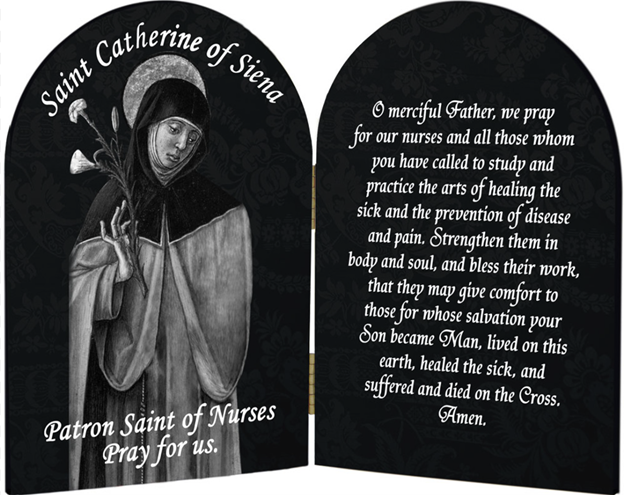
O merciful Father, who have wonderfully fashioned man in your own image, and have made his body to be a temple of the Holy Spirit, sanctify, we pray you, our doctors and nurses and all those whom you have called to study and practice the arts of healing the sick and the prevention of disease and pain. Strengthen them in body and soul, and bless their work, that they may give comfort to those for whose salvation your Son became Man, lived on this earth, healed the sick, and suffered and died on the Cross. Amen.
This invocation, rooted in Catherine’s plague-era service, reminds us: Nursing isn’t just technique; it’s a sacred imitation of the Suffering Servant.
Invoking Catherine in the Chaos: Modern Moments for Her Prayer
Catherine’s fire-tested faith—legend says flames meant to burn her as a heretic extinguished at her touch—equips her to intercede in our “fires” of trial (Curtayne, 2018). In a world of pandemics, shortages, and moral mazes, her prayer isn’t whispered in cloisters but gasped in scrubs. Here are key situations where TradNurses might invoke it, drawing on her legacy of endurance:
- Pandemic Overload and Burnout: Echoing the Black Death’s horrors, COVID-19’s waves left nurses intubating the isolated, rationing PPE, and grieving waves of loss. Invoke Catherine before a grueling shift when exhaustion whispers defeat. Her prayer fortifies the soul, as one ICU nurse shared post-2020: “Reciting it at dawn steadied me, reminding me each patient was Christ’s face” (Garlick, 2023). With 52% of nurses eyeing exit by 2026 due to burnout (Reuters, 2025), it’s a bulwark against despair.
- Ethical Storms in Care: When hospital policies clash with conscience—e.g., end-of-life decisions or pressure to hasten death—Catherine’s bold letters to popes model prophetic witness. Pray it amid debates over assisted suicide or resource triage, seeking clarity to “see Christ in the sick,” as the prayer urges (Catholic to the Max, n.d.). Her intercession aids nurses navigating ridicule for faith-driven stands, like refusing procedures against Church teaching.
- Shortages and Systemic Strain: Amid staffing crises and funding cuts—like the 2025 shutdown’s ripple on Medicaid—Catherine’s resourcefulness shines. She begged alms for the dying; we ration beds. Whisper the prayer during inventory checks or union pleas, invoking her for “blessed work” that comforts despite scarcity (Kaiser Family Foundation, 2025).
- Personal Trials of Illness or Miscarriage: As patroness against illness and miscarriage, Catherine comforts nurses facing their own health battles or supporting grieving families. A labor-and-delivery RN might pray it after a loss, channeling Catherine’s vow of virginity into vows of fidelity amid pain (Psalm 91, 2021).
- Daily Discernment and Renewal: Start shifts with it for humility, or end with gratitude. Nursing students, prepping for boards or clinicals, can invoke her for the “arts of healing,” mirroring her shift from seclusion to service (Patron Saint Medals, n.d.).
In these moments, Catherine’s prayer isn’t rote; it’s a lifeline, weaving her 14th-century mercy into our 21st-century scrubs.
A Timeless Call: Carry Her Flame Forward
St. Catherine of Siena teaches us that the true fire of nursing isn’t burnout; it’s the blaze of charity that consumes the self for others. Her prayer, born from plague and prophecy, equips us to heal bodies while mending souls, in a world that often forgets the temple within. As TradNurses, let’s etch it on our hearts: Strengthen us, Lord, through her. On her feast, April 29, or any midnight shift, let it rise like incense.
When do you turn to St. Catherine? Share in the comments—your story might steady a sister’s hand.
References
Bell, R. (2019). Holy anarchy: The history of St. Catherine of Siena. Penguin Books.
Catholic Online. (n.d.). St. Catherine of Siena. https://www.catholic.org/saints/saint.php?saint_id=9
Catholic to the Max. (n.d.). Bookends: St. Catherine of Siena Nurse’s Prayer. https://www.catholictothemax.com/catholic-home-decor/st-catherine-of-siena-nurses-prayer-bookends/
Catherine of Siena. (1980). The dialogue (S. Noffke, Trans.). Paulist Press. (Original work published 1378)
Curtayne, A. (2018). St. Catherine of Siena. TAN Books. (Original work published 1929)
Garlick, L. (2023). #086 St. Catherine of Siena – Nurses. https://www.garlickretablos.com/products/086-st-catherine-of-seina-patron-saint-nurses
John Paul II. (1999). Apostolic letter on St. Catherine of Siena. https://www.vatican.va/content/john-paul-ii/en/apost_letters/1999/documents/hf_jp-ii_apl_19990429_caterina-da-siena.html
Kaiser Family Foundation. (2025). Nursing workforce trends: Burnout and retention. https://www.kff.org/health-reform/nursing-shortage-2025
Noffke, S. (2008). Catherine of Siena: The dialogue (Classics from the Fenwick collection, Vol. 1). Paulist Press.
Patron Saint Medals. (n.d.). Patron saint of nurses: Who is it and why? https://www.patronsaintmedals.com/patron-saint-of/nurses
Prayers to Our Saints. (n.d.). St. Catherine of Siena Prayer. http://www.prayerstooursaints.com/saint-catherine-of-siena-prayer.htm
Psalm 91. (2021). Prayer to Saint Catherine of Siena [Miscarriage and Abortion]. https://psalm91.com/prayer-to-saint-catherine-of-siena/
Reuters. (2025). U.S. nursing workforce trends: Burnout and retention 2025. https://www.reuters.com/health/nursing-shortage-2025
Savelli Religious. (2025). Patron saint of nursing: St. Catherine of Siena. https://savellireligious.com/blogs/blog/st-catherine-of-siena-patron-saint-of-nurses